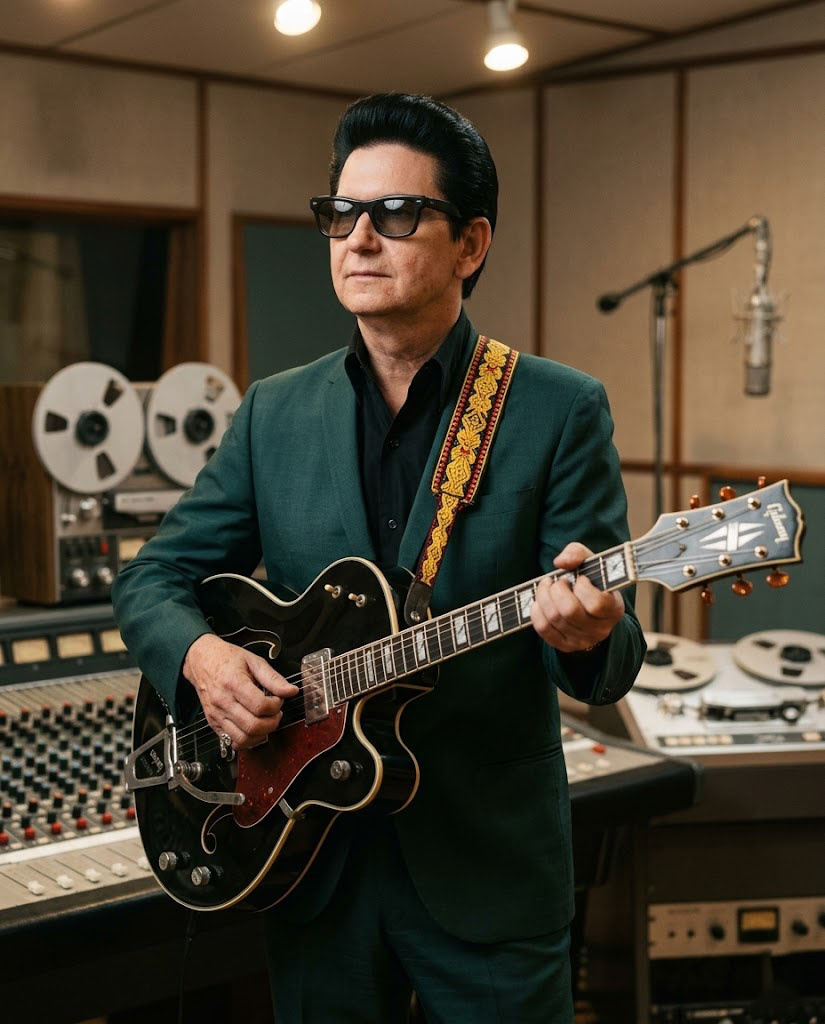
“HE BARELY MOVED DURING ‘MEAN WOMAN BLUES’ — BUT SOMEHOW ROY ORBISON MADE THE ENTIRE STAGE FEEL LIKE IT MIGHT CATCH FIRE…”
By 1965, rock and roll had become a contest of volume and motion. Singers twisted across stages. Bands pushed louder amplifiers. The energy was supposed to feel explosive at all times.
Then Roy Orbison walked into the Monument Concert almost completely still.
And somehow became impossible to ignore.
“Mean Woman Blues” already carried the raw engine of classic rockabilly. The piano pounded forward. The guitars snapped sharply through the room. The rhythm moved with the restless momentum of a train that had stopped trying to slow down.
But Orbison approached the song differently from almost everyone else.
He did not attack it wildly.
He controlled it.
Standing beneath the lights in black clothes and dark glasses, he barely shifted his body at all. There were no dramatic gestures asking the audience for attention. No reckless swagger trying to dominate the room.
Just focus.
And that restraint changed the entire atmosphere of the performance.
Because underneath the fast tempo, Orbison uncovered something darker hiding inside the song. Other singers often treated “Mean Woman Blues” like pure excitement — loud, playful, dangerous in the familiar rock and roll sense.
Orbison made it sound personal.
Almost haunted.
You could hear tension underneath every vocal line, as though desire and destruction were pulling against each other in real time. His voice rose tightly instead of freely, carrying the feeling of someone trying to hold emotion together rather than release it.
That pressure became the performance.
The audience felt it immediately.
There is something strangely cinematic about the Monument version of “Mean Woman Blues.” The rhythm keeps surging forward while Orbison remains nearly motionless in the center of it all, calm against the chaos surrounding him. It created a contradiction people could not stop watching.
Stillness against noise.
Control against impulse.
That was always part of Roy Orbison’s mystery. Even in fast songs, heartbreak followed him somewhere beneath the surface. He could sing about obsession, longing, or danger without ever sounding theatrical. The emotion never felt performed.
It felt contained.
Which made it more powerful.
By the mid-1960s, music itself was already beginning to shift around him. The British Invasion had changed radio almost overnight. Younger bands arrived louder, sharper, faster. Rock stars increasingly built their identities around rebellion and spectacle.
Orbison remained completely separate from all of it.
He never chased trends.
He never reshaped himself into something more fashionable.
Instead, he stood almost perfectly still and trusted the voice to carry the weight alone.
And it did.
What made performances like “Mean Woman Blues” endure was not simply the quality of the singing. It was the emotional precision underneath it. Orbison understood that intensity becomes stronger when held back slightly. He left space around the emotion instead of pushing it too hard.
The audience leaned in because they could feel what was barely being restrained.
That kind of tension does not age.
Even decades later, the Monument Concert performance still feels startlingly alive. Not because it was chaotic. Not because it was wild in the traditional rock and roll sense.
Because it felt dangerous without ever losing control.
Quietly dangerous.
Like something held together by discipline alone.
And maybe that is why Roy Orbison still feels different from almost every performer of his era. While others tried to overwhelm audiences with movement, he trusted silence, restraint, and vulnerability to do the harder work.
Because Roy Orbison understood that the most unforgettable performances are not always the loudest ones — sometimes they are the ones trembling just beneath the surface…