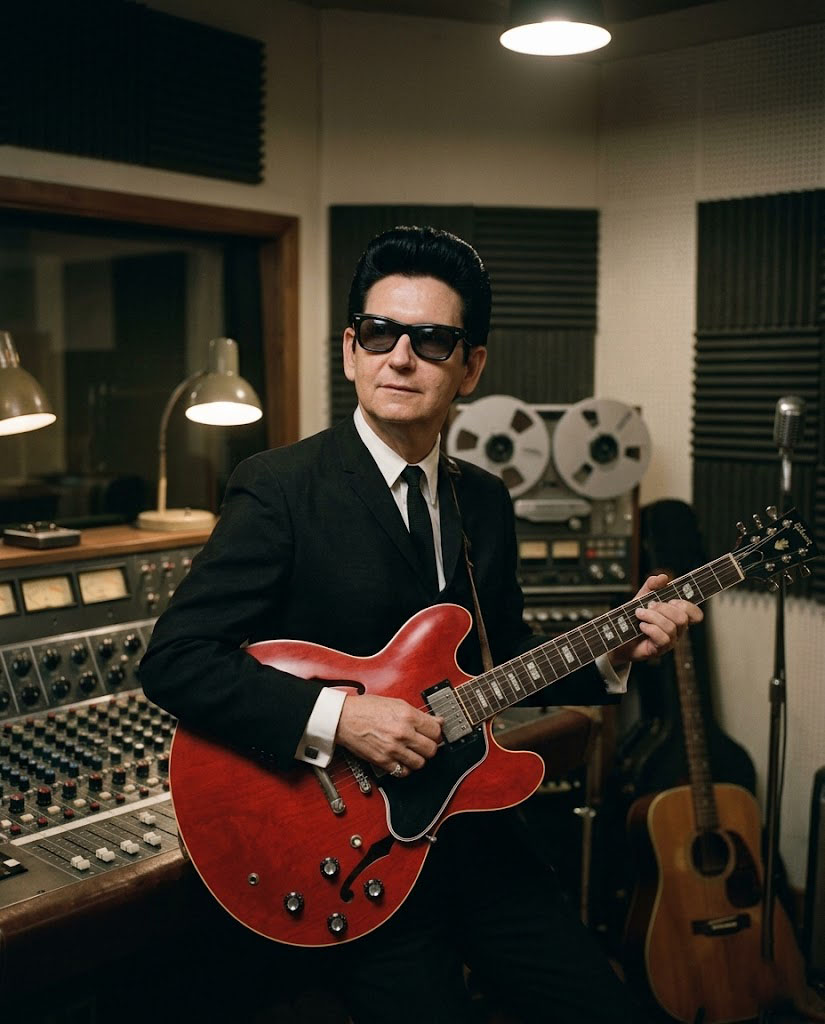
HE STOOD ALMOST MOTIONLESS — AND SOMEHOW MADE THE WHOLE WORLD ACHE…
Roy Orbison did not need to dance, swagger, or chase the crowd.
He stood in black, behind dark glasses, almost still beneath the stage lights, and then that voice rose — high, wounded, and beautiful enough to make silence feel like part of the song.
That was the event people remembered first.
A man barely moving, yet filling the room with heartbreak so large it seemed to belong to everyone. In a world that often rewarded noise, Roy Orbison proved that stillness could be louder.
Before the legend, he was a Texas boy chasing music through small towns, radio stations, and long nights on the road. He did not look like the typical star. He did not perform desire the way others did. He carried something stranger.
Distance.
Mystery.
Pain held carefully in both hands.
Then, in 1960, “Only the Lonely” changed everything.
The song did not simply make Roy famous. It gave loneliness a shape. It sounded like a man standing at the edge of his own heart, trying to describe the room inside him where no one else had been.
And America listened.
Not casually.
Closely.
“Crying” came next, and the title told the truth before the first note even landed. “In Dreams” felt like grief walking through a dark hallway. “Oh, Pretty Woman” gave him a flash of swagger, but even there, beneath the famous guitar line, Roy still sounded like a man watching happiness pass close enough to touch.
His voice could climb higher than seemed possible.
But it never felt like showing off.
It felt like reaching.
That was Roy Orbison’s gift. He could sing a note so high it seemed to leave the earth, then bring it back carrying something bruised and human. He made heartbreak feel almost sacred, not because he exaggerated it, but because he respected it.
Then life gave him more sorrow than any song should have to hold.
In 1966, his wife, Claudette, died in a motorcycle accident. Two years later, while Roy was on tour, a fire at his home took the lives of two of his sons.
There are losses people discuss.
And there are losses people simply stand beside in silence.
For Roy, the dark glasses were often treated like a symbol of mystery. But after enough pain, mystery becomes the easier explanation. Maybe what people saw as distance was really survival. Maybe the black clothes were not theater at all.
Maybe they were shelter.
And still, he sang.
That is the part that stays.
He did not sing as if life was fair. He did not ask the audience to believe pain could be neatly solved by the final chorus. He sang like someone who knew grief could live in the same house as beauty, and sometimes share the same breath.
In the 1980s, a new generation found him again.
Artists who had grown up under the spell of that voice stood beside him with reverence. It did not feel like a comeback made from ambition. It felt like a door opening for a man who had been waiting in the dark, still carrying the sound no one else could make.
Roy Orbison died in 1988.
But voices like his do not leave the room all at once.
Some singers become legends by filling the stage; Roy Orbison became one by standing still and letting the wound sing…