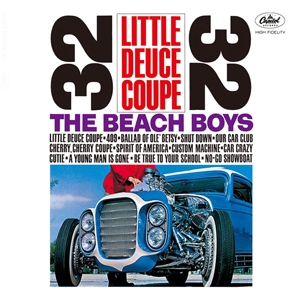
Released in July 1963 as the B-side to the single Surfer Girl and as the title track of the Beach Boys’ fourth album, Little Deuce Coupe, this song is a quintessential anthem of 1960s car culture, showcasing the band’s ability to tap into the era’s youth obsessions. Written by Brian Wilson and Roger Christian, the track was produced by Brian Wilson and recorded on June 12, 1963, at Western Studios in Los Angeles. Featuring the Beach Boys—Brian, Carl, and Dennis Wilson, Mike Love, and David Marks (with Al Jardine temporarily absent)—the song reached #15 on the Billboard Hot 100 as a B-side, a notable achievement given its pairing with the #7 hit Surfer Girl.
Little Deuce Coupe emerged during the Beach Boys’ rapid ascent in the early 1960s. Following the success of Surfin’ U.S.A. earlier in 1963, the band was cementing its identity as chroniclers of California’s surf and car cultures. The song, and its accompanying album, marked a strategic shift toward car-themed music, capitalizing on the hot rod craze popularized by magazines like Hot Rod and films like American Graffiti (released later in 1973). As one of the first concept albums in rock, Little Deuce Coupe (the album) was a bold move, focusing entirely on cars and cruising, with the title track setting the tone.
The recording process showcased Brian Wilson’s growing production skills. At 21, he crafted a tight, upbeat track with a Chuck Berry-inspired rock ‘n’ roll energy, featuring Carl Wilson’s jangly guitar and Hal Blaine’s driving drums from the Wrecking Crew. Mike Love’s lead vocal exuded swagger, while the band’s harmonies added a polished sheen. The song’s release as a B-side ensured it reached a wide audience, and its inclusion on the album, which peaked at #4 on the Billboard 200, solidified the Beach Boys’ commercial dominance before the British Invasion intensified in 1964.
Little Deuce Coupe had a lasting cultural impact. It became a staple of oldies radio, covered by bands like The Rip Chords and featured in car culture media. The song’s celebration of the 1932 Ford Coupe (“deuce” referring to the year) immortalized a classic hot rod, influencing car enthusiasts and reinforcing California’s image as a hub of youth culture. While its male-centric narrative reflects 1960s gender norms, the song’s infectious energy ensures its enduring appeal, evoking the thrill of cruising in a bygone era.
Inspiration and Creation
The inspiration for Little Deuce Coupe stemmed from the Beach Boys’ immersion in Southern California’s car culture, a defining aspect of 1960s youth identity. Brian Wilson, though not a car enthusiast himself, was fascinated by the hot rod scene, where customized cars like the 1932 Ford Coupe symbolized freedom, status, and rebellion. He collaborated with Roger Christian, a radio DJ and car aficionado who had co-written earlier Beach Boys car songs like 409. Christian’s knowledge of hot rod terminology—flathead mills, four-speed transmissions—gave the lyrics authenticity, while Brian’s melody captured the thrill of driving.
Brian’s creative process was driven by a desire to expand the Beach Boys’ thematic range beyond surfing. He saw car culture as a natural complement, given its overlap with the teenage audience that fueled their success. The song’s concept—a boastful ode to a souped-up car—was inspired by real-life drag racing scenes in Los Angeles, where teens modified cars for speed and style. Brian composed the melody on piano, drawing on Chuck Berry’s rhythmic drive and the upbeat energy of early rock ‘n’ roll. The lyrics, penned by Christian, used car jargon to create a vivid portrait of a “competition clutch” and “four on the floor,” appealing to gearheads while remaining accessible to casual listeners.
Recording sessions in June 1963 were efficient, reflecting Brian’s confidence as a producer. Working with engineer Chuck Britz, he used Western’s three-track recorder to layer vocals and instruments. The Wrecking Crew, including guitarist Billy Strange and bassist Ray Pohlman, provided a rock-solid foundation, while Carl’s guitar riff echoed Berry’s Maybellene. Mike’s lead vocal, with its cocky delivery, matched the song’s bravado, and the harmonies, featuring Brian’s falsetto, added a Beach Boys signature. The track’s arrangement, with its stop-start dynamics and handclaps, was designed for radio and live performances, ensuring maximum impact.
External factors shaped the song’s creation. Capitol Records, buoyed by Surfin’ U.S.A.’s success, encouraged the Beach Boys to explore car themes to broaden their appeal, especially in landlocked regions where surfing was less relatable. The 1963 music scene, with its mix of surf rock, doo-wop, and early British Invasion precursors, demanded catchy, youth-oriented songs. Little Deuce Coupe’s release in July 1963, at the height of summer, tapped into the cruising culture, resonating with teens who saw cars as extensions of their identity.
Themes and Conveyed Content
Lyrically, Little Deuce Coupe is a boastful celebration of car culture and youthful pride. The narrator brags about his customized 1932 Ford Coupe, detailing its “flathead mill” and “four-barrel carb” with technical swagger. Lines like “She’s my little deuce coupe, you don’t know what I got” convey confidence and exclusivity, while the chorus’s repetition reinforces the car’s iconic status. Mike’s energetic vocal, paired with the band’s harmonies, amplifies the song’s exuberant tone, inviting listeners to share in the excitement.
The song’s themes reflect the 1960s’ obsession with cars as symbols of freedom, status, and masculinity. The “little deuce coupe” is more than a vehicle; it’s a badge of coolness, outshining competitors on the drag strip and in the eyes of peers. The focus on technical details appeals to the era’s gearhead subculture, while the narrative of outrunning “big street machines” captures the competitive spirit of youth. Unlike later Beach Boys songs like Don’t Worry Baby, which explored emotional vulnerability, Little Deuce Coupe is unapologetically fun, offering an escape from the era’s tensions, including the Cold War and early civil rights struggles.
Musically, Little Deuce Coupe conveys energy and excitement. The uptempo rhythm and rock ‘n’ roll guitar riff evoke the thrill of speeding down a highway, while the harmonies and handclaps create a communal, sing-along vibe. The production’s clarity, with its crisp instrumentation and dynamic shifts, balances raw energy with pop polish, making it ideal for radio play. The song’s structure, with its concise verses and catchy chorus, mirrors the quick, adrenaline-fueled world of drag racing.
Culturally, Little Deuce Coupe reinforced the Beach Boys’ role as chroniclers of California youth culture, alongside Surfin’ Safari. For listeners nationwide, it painted a fantasy of cruising under palm trees, boosting California’s allure as a hub of coolness. Its male-centric focus, with the car as a stand-in for masculine prowess, reflects 1960s gender norms, though its universal celebration of freedom mitigates modern critique. The song’s timeless appeal lies in its joyful depiction of youth, speed, and pride, evoking the open-road dreams of a vibrant era.
Lyrics
Little deuce coupe
You don’t know what I got
Little deuce coupe
You don’t know what I got
Well I’m not braggin’ babe so don’t put me down
But I’ve got the fastest set of wheels in town
When something comes up to me he don’t even try
‘Cause if I had a set of wings man I know she could fly
She’s my little deuce coupe
You don’t know what I got
(My little deuce coupe)
(You don’t know what I got)
Just a little deuce coupe with a flathead mill
But she’ll walk a Thunderbird like she’s standin’ still
She’s ported and relieved and she’s stroked and bored
She’ll do a hundred and forty with the top end floored
She’s my little deuce coupe
You don’t know what I got
(My little deuce coupe)
(You don’t know what I got)
She’s got a competition clutch with the four on the floor
And she purrs like a kitten ’til the lake pipes roar
And if that ain’t enough to make you flip your lid
There’s one more thing, I got the pink slip daddy
And comin’ off the line when the light turns green
Well she blows ’em outta the water like you never seen
I get pushed out of shape and it’s hard to steer
When I get rubber in all four gears
She’s my little deuce coupe
You don’t know what I got
(My little deuce coupe)
(You don’t know what I got)
She’s my little deuce coupe
You don’t know what I got
(My little deuce coupe)
(You don’t know what I got)