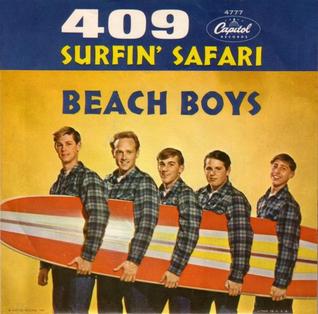
Released in June 1962 as the B-side to the Beach Boys’ debut single Surfin’ Safari and included on their first album, Surfin’ Safari, 409 is a raw, energetic rock song that introduced the band’s fascination with car culture, complementing their surf rock identity. Written by Brian Wilson, Gary Usher, and Mike Love, the song was produced by Murry Wilson, the band’s manager and father of Brian, Carl, and Dennis Wilson, and recorded in April 1962 at Western Studios in Los Angeles. Featuring the original Beach Boys lineup—Brian, Carl, and Dennis Wilson, Mike Love, and Al Jardine—the single reached #76 on the Billboard Hot 100, a modest but notable achievement for a B-side paired with the #14 hit Surfin’ Safari.
409 emerged during the Beach Boys’ formative years, as they transitioned from a local act to national stars. Their debut single Surfin’ (1961) had gained regional traction, leading to a Capitol Records deal, and Surfin’ Safari capitalized on the 1962 surf craze. 409, named after the Chevrolet 409-cubic-inch V8 engine, tapped into the parallel hot rod culture, popularized by car clubs, drag racing, and magazines like Hot Rod. The song’s release coincided with the band’s efforts to define their sound, blending surf and car themes to appeal to a broad teenage audience, setting the stage for later car anthems like Little Deuce Coupe (1963).
The recording process was rudimentary, reflecting the band’s inexperience and limited budget. Brian Wilson, at 19, showed early production instincts, working with engineer Chuck Britz to capture a gritty, high-energy sound. The band handled most instrumentation—Carl on guitar, Dennis on drums, Brian on bass, and Al on rhythm guitar—with session musician Ernie Bringas adding a saxophone riff. Mike Love’s lead vocal delivered youthful bravado, while the band’s nascent harmonies added charm. The song’s B-side success helped the Surfin’ Safari album peak at #32, marking the Beach Boys’ entry into the national spotlight.
409 had a significant cultural impact. It helped establish the Beach Boys as pioneers of car-themed rock, influencing acts like Jan and Dean and reinforcing California’s image as a hub of youth rebellion. Featured in hot rod nostalgia media, it remains a classic of early 1960s rock. Its male-centric narrative and technical focus reflect the era’s norms, but its universal celebration of speed and freedom ensures its enduring appeal, capturing the raw energy of the Beach Boys’ debut era.
Inspiration and Creation
The inspiration for 409 came from Brian Wilson’s exposure to Southern California’s vibrant car culture, though he was not a car enthusiast himself. Gary Usher, a friend and aspiring songwriter, was a gearhead obsessed with hot rods, particularly the Chevrolet 409 engine, known for its power in drag racing. Usher’s enthusiasm, combined with the Beach Boys’ desire to expand beyond surf themes, sparked the song’s concept—a boastful ode to a souped-up Chevy. Mike Love contributed lyrics, adding a teenage perspective and catchy phrases like “giddy up, giddy up,” evoking the thrill of speed.
Brian’s creative process was rooted in his love for early rock ‘n’ roll, drawing on the driving rhythms of Chuck Berry and the raw energy of Little Richard. He composed the melody on piano, creating a fast-paced, three-chord structure that mirrored the acceleration of a drag race. Usher’s lyrics, polished by Brian and Mike, used car jargon—“four-speed, dual-quad, Positraction”—to appeal to hot rod fans, while the narrative of outrunning rivals captured teenage bravado. The phrase “giddy up,” inspired by horse-racing calls, became a hook, blending car and cowboy imagery for a playful, rebellious vibe.
Recording sessions in April 1962 were a learning curve for the young band. Murry Wilson oversaw production, with Brian asserting early creative control. The band recorded at Western Studios, using a basic three-track setup. Carl’s twangy guitar riff, inspired by surf instrumentals like The Ventures, drove the track, while Dennis’s energetic drumming added propulsion. Brian and Al handled bass and rhythm parts, with Bringas’s saxophone riff injecting a rockabilly edge. Mike’s lead vocal, backed by the band’s rough but enthusiastic harmonies, conveyed excitement, though the production’s rawness reflected their novice status.
External factors shaped the song’s creation. Capitol Records, eager to capitalize on the surf craze with Surfin’ Safari, saw 409 as a way to broaden the band’s appeal, especially in car-centric regions like the Midwest. The 1962 music scene, dominated by doo-wop, early rock, and emerging pop, demanded high-energy, youth-oriented songs. Released in June 1962, at the start of summer, 409 tapped into the hot rod craze, resonating with teens who idolized cars as symbols of freedom and status.
Themes and Conveyed Content
Lyrically, 409 is a boastful celebration of car culture, speed, and youthful pride. The narrator brags about his Chevrolet 409, describing its “four-speed, dual-quad, Positraction” and its ability to “walk anybody’s dog” on the drag strip. The repetitive “giddy up, giddy up” mimics engine revs, while lines like “She’s so fine, my 409” personify the car as a beloved companion. Mike’s swaggering vocal, paired with the band’s harmonies, amplifies the song’s cocky, high-energy tone, immersing listeners in the thrill of a street race.
The song’s themes reflect the early 1960s’ obsession with cars as symbols of freedom, masculinity, and rebellion. The 409, a real engine prized by hot rodders, embodies power and status, with the narrator’s dominance over rivals affirming his coolness. The drag race narrative captures the competitive spirit of youth, resonating with teens seeking identity in a conformist era. Unlike later Beach Boys songs like In My Room, 409 is unabashedly bold, offering an escapist thrill amid Cold War anxieties and societal pressures, celebrating the open road’s allure.
Musically, 409 conveys adrenaline and excitement. The uptempo rhythm, driven by Carl’s guitar and Dennis’s drums, evokes the roar of a revving engine, while the saxophone riff adds a rockabilly swagger. The harmonies, though raw compared to later works, create a communal vibe, as if the band is cheering the driver on. Brian’s production, despite its simplicity, captures the song’s gritty energy, with handclaps and vocal flourishes enhancing its live-band feel, ideal for car radios and teenage hangouts.
Culturally, 409 established the Beach Boys as pioneers of car-themed rock, alongside their surf anthems, influencing pop culture from hot rod magazines to drag racing events. For listeners nationwide, it painted a fantasy of California’s car-centric lifestyle, boosting the state’s allure as a youth mecca. Its male-centric focus, with the car as a masculine symbol, reflects 1960s gender norms, but its universal celebration of speed mitigates modern critique. The song’s timeless appeal lies in its raw depiction of youthful bravado, evoking the pulse-pounding thrill of a drag race.
Lyrics
She’s real fine, my 409
She’s real fine, my 409
My 409
Well I saved my pennies and I saved my dimes
(Giddy up, giddy up 409)
For I knew there would be a time
(Giddy up, giddy up 409)
When I would buy a brand new 409
(409, 409)
Giddy up, giddy up, giddy up 409
(Giddy up, giddy up 409)
Giddy up 409
(Giddy up, giddy up 409)
Giddy up 409
(409, 409)
Nothing can catch her
Nothing can touch my 409
409, ooh
When I take her to the track she really shines
(Giddy up, giddy up 409)
She always turns in the fastest times
(Giddy up, giddy up 409)
My four-speed, dual-quad, Positraction 409
(409, 409)
Giddy up, giddy up, giddy up 409
(Giddy up, giddy up 409)
Giddy up 409
(Giddy up, giddy up 409)
Giddy up 409
(409, 409)