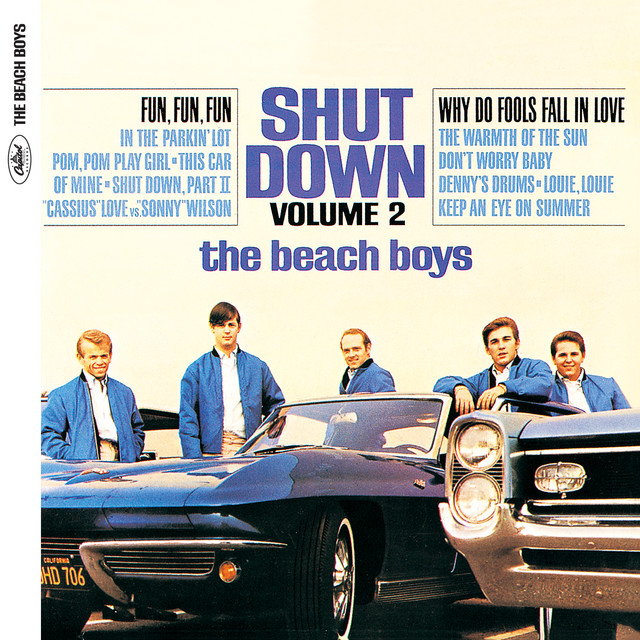
Released in March 1963 as a single and included on the Beach Boys’ albums Surfin’ U.S.A. and Little Deuce Coupe, Shut Down is a high-energy rock anthem that epitomizes the band’s early fascination with car culture and their knack for crafting vivid, youth-oriented narratives. Written by Brian Wilson and Roger Christian, the song was produced by Brian Wilson and recorded on January 5, 1963, at Western Studios in Los Angeles. Featuring the Beach Boys—Brian, Carl, and Dennis Wilson, Mike Love, and David Marks (with Al Jardine temporarily absent)—the single reached #23 on the Billboard Hot 100, a solid performance for a B-side paired with the #3 hit Surfin’ U.S.A.
Shut Down emerged during the Beach Boys’ rapid rise in the early 1960s, following their breakthrough with Surfin’ Safari (1962). In 1963, the band was capitalizing on the surf craze while expanding into car culture, a parallel youth obsession fueled by hot rod magazines, drag racing, and films like Rebel Without a Cause. The song, which describes a drag race between a Dodge Dart and a Chevrolet Corvette Sting Ray, captured the thrill of speed and competition, complementing the Surfin’ U.S.A. album’s beach vibe and the Little Deuce Coupe album’s car focus. Its inclusion on both albums, which peaked at #2 and #4 respectively, underscored its popularity and the band’s strategic thematic shift.
The recording process highlighted Brian Wilson’s early production prowess. At 20, he crafted a tight, adrenaline-pumping track with Carl Wilson’s twangy guitar riff, Dennis Wilson’s propulsive drumming, and a punchy rhythm section from the Wrecking Crew, including Hal Blaine. Mike Love’s lead vocal exuded swagger, while the band’s harmonies added a polished sheen. The song’s B-side status ensured it reached a wide audience, and its raw energy made it a staple in early live performances, helping the Beach Boys compete with acts like The Four Seasons before the British Invasion intensified in 1964.
Shut Down had a significant cultural impact. It became a defining anthem of 1960s car culture, influencing bands like Jan and Dean and featured in media celebrating hot rod nostalgia, such as American Graffiti (1973). The song reinforced California’s image as a hub of youth rebellion, boosting the popularity of drag racing and custom cars. While its male-centric narrative and technical jargon reflect 1960s norms, its universal themes of competition and thrill ensure its enduring appeal, making it a classic of the Beach Boys’ early catalog.
Inspiration and Creation
The inspiration for Shut Down came from the Beach Boys’ engagement with Southern California’s thriving car culture, a defining aspect of 1960s youth identity. Brian Wilson, though not a gearhead, was fascinated by the hot rod scene, where customized cars and drag racing symbolized freedom, status, and rebellion. He collaborated with Roger Christian, a radio DJ and car enthusiast who had co-written 409 (1962), to craft a song that captured the excitement of a street race. Christian’s knowledge of car terminology—fuel injection, tachometers, and Super Stocks—gave the lyrics authenticity, while Brian’s melody conveyed the rush of speed.
Brian’s creative process was rooted in his love for rock ‘n’ roll, particularly the rhythmic drive of Chuck Berry and the upbeat energy of early surf instrumentals by Dick Dale. He composed the melody on piano, creating a fast-paced, syncopated riff that mirrored the acceleration of a drag race. Christian’s lyrics, polished with Brian’s input, narrated a tense showdown between a Dodge 413 and a Sting Ray, using jargon like “fuel-injected Sting Ray” and “tach it up” to appeal to car enthusiasts. The term “shut down,” slang for winning a race by outpacing the opponent, became the song’s hook, evoking triumph and bravado.
Recording sessions on January 5, 1963, were energetic and efficient. Brian, as producer, worked with engineer Chuck Britz at Western Studios, using a three-track recorder to capture the band’s raw vitality. Carl’s guitar riff, inspired by Berry’s Johnny B. Goode, drove the track, while Dennis’s drumming and Blaine’s percussion added a relentless pulse. Brian and David Marks handled bass and rhythm guitar, with the Wrecking Crew’s horns adding a punchy flourish. Mike’s lead vocal, backed by Brian’s falsetto and the band’s harmonies, conveyed confidence, with meticulous overdubbing ensuring a crisp, radio-ready sound.
External factors shaped the song’s creation. Capitol Records, buoyed by Surfin’ Safari’s success, encouraged the band to explore car themes to broaden their appeal, especially in landlocked regions where surfing was less relevant. The 1963 music scene, with its mix of surf rock, doo-wop, and emerging pop, demanded high-energy, youth-oriented songs. Shut Down’s release in March 1963, paired with Surfin’ U.S.A., tapped into the hot rod craze, resonating with teens who saw cars as extensions of their identity.
Themes and Conveyed Content
Lyrically, Shut Down is a vivid narrative of competition, triumph, and youthful bravado. The narrator describes a drag race, pitting his Dodge 413 against a “fuel-injected Sting Ray.” Technical details—“My four-speed, dual-quad, Positraction four-oh-nine”—add authenticity, while lines like “Tach it up, tach it up, buddy, gonna shut you down” convey confidence and challenge. Mike’s swaggering vocal, paired with the band’s tight harmonies, amplifies the song’s high-stakes energy, immersing listeners in the race’s thrill.
The song’s themes reflect the early 1960s’ obsession with car culture and masculine prowess. The drag race symbolizes competition and status, with the narrator’s victory affirming his skill and coolness, resonating with teens seeking identity in a conformist era. Cars, portrayed as powerful extensions of self, embody freedom and rebellion, aligning with the era’s fascination with speed and individuality. Unlike introspective Beach Boys songs like In My Room, Shut Down is unapologetically bold, offering an escapist thrill amid Cold War anxieties and societal pressures.
Musically, Shut Down conveys adrenaline and excitement. The uptempo rhythm, driven by Carl’s guitar and Dennis’s drums, evokes the roar of engines, while the horns and handclaps add a celebratory edge. The harmonies, vibrant and precise, create a communal vibe, as if the band is cheering the racer on. Brian’s production, with its crisp instrumentation and dynamic shifts, balances raw rock energy with pop polish, making the song ideal for radio and car stereos.
Culturally, Shut Down solidified the Beach Boys’ role as chroniclers of 1960s youth culture, expanding their surf identity to include car culture. For listeners nationwide, it painted a fantasy of California’s drag strips, boosting the hot rod scene’s allure and influencing pop culture from car shows to films. Its male-centric focus, with cars as masculine symbols, reflects 1960s gender norms, but its universal celebration of competition mitigates modern critique. The song’s timeless appeal lies in its thrilling depiction of speed and victory, evoking the pulse-pounding excitement of a race.
Lyrics
Tach it up, tach it up
Buddy gonna shut you down
It happened on the strip where the road is wide
(Ooh rev it up now)
Two cool shorts standin’ side by side
(Ooh rev it up now)
Yeah, my fuel-injected Sting Ray and a four-thirteen
(Ooh rev it up now)
Revvin’ up our engines and it sounds real mean
(Ooh rev it up now)
Tach it up, tach it up
Buddy gonna shut you down
Declinin’ numbers at an even rate
(Ooh shift it up now)
At the count of one we both accelerate
(Ooh shift it up now)
My Sting Ray is light, the slicks are startin’ to spin
(Ooh shift it up now)
But the four-thirteen’s really diggin’ in
(Ooh shift it up now)
Tach it up, tach it up
Buddy gonna shut you down
Gotta be cool now, power shift here we go
Super Stock Dart is windin’ out in low
But my fuel-injected Sting Ray’s really startin’ to go
To get the traction I’m ridin’ the clutch
My pressure plate’s burnin’, that ain’t no fuss
Tach it up, tach it up
Buddy gonna shut you down