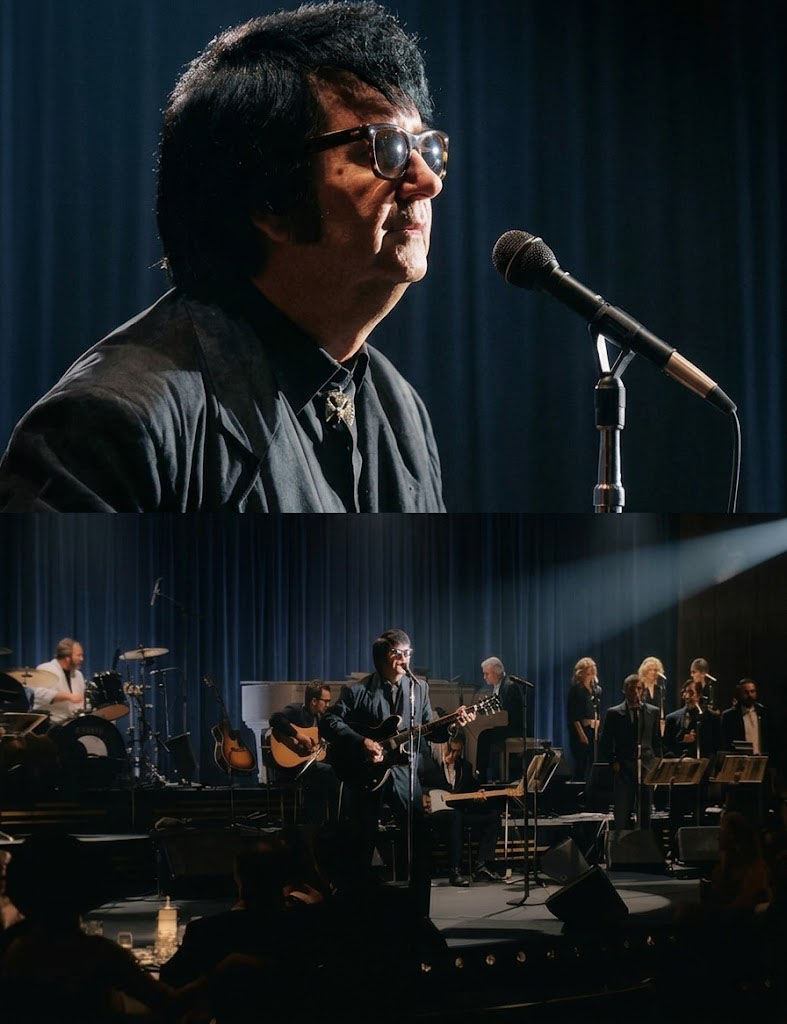
THE WORLD SAW A MAN IN DARK GLASSES STANDING PERFECTLY STILL—BUT BEYOND THE LENSES WAS A HEART THAT ONLY FOUND PEACE IN THE SHADOWS OF A DREAM…
In 1987, at the Coconut Grove in Los Angeles, Roy Orbison stepped onto a stage bathed in cinematic monochrome light. He did not need pyrotechnics, backup dancers, or flashy movements to command the heavy air of the room.
Surrounded by a hand-picked band of disciples—legends like Bruce Springsteen, Elvis Costello, and James Burton—Roy delivered a version of “In Dreams” that felt less like a performance and more like a final confession. It was the definitive moment of a career built on the quiet dignity of a broken heart.
This was not just another concert for a veteran star. It was the night the world realized that while the man had aged and the industry had changed, the voice remained a celestial, untouched force.
THE ARCHITECTURE OF A VISION
The song “In Dreams” had first graced the airwaves in April 1963, reaching the Top 10 during an era of surf rock and the early rumblings of the British Invasion. It stood in stark contrast to everything else on the radio.
Roy famously claimed the melody came to him in that fragile, ethereal state between sleeping and waking. He heard the entire arrangement—the crying strings and the steady bolero beat—before he ever put a pen to paper.
Unlike the standard verse-chorus structure of the time, the song is a through-composed odyssey. It does not repeat itself; it only ascends, moving through stages of a dream until it reaches an operatic climax.
THE STILLNESS OF A LEGEND
On that black and white night, the atmosphere was thick with a specific kind of reverence. The legends backing him played with a hushed intensity, making sure never to overshadow the man in the center.
Roy stood like a dark statue, his Gibson ES-335 resting against his signature black suit. He never moved his feet. He barely even shifted his weight as his three-octave range began to climb.
The power of the moment resided in his absolute restraint, proving that the loudest emotions often come from the quietest men.
He sang of the “Sandman,” a folklore character he repurposed as a bittersweet gatekeeper. In Roy’s world, the Sandman wasn’t a bringer of peace, but a facilitator of a beautiful, cruel illusion.
For a man who had lost a wife and two sons to unthinkable tragedies, the lyrics carried a weight that no one else could replicate. He wasn’t just singing a hit; he was navigating his own history.
A MELODY WITHOUT END
As the song reached its final, soaring high note, the room held its breath. There was no strain in his throat, only a pure, velvet clarity that seemed to vibrate in the very bones of the audience.
The performance ended with a whispered recognition of reality. The “Candy-Colored Clown” of sleep had retreated, leaving only the “blue tomorrow” and the loneliness of the waking world.
In that final, haunting echo, Roy Orbison showed us that some memories are too heavy to carry in the light of day.
One year after this recording, Roy was gone. He left behind a legacy of songs that serve as a sanctuary for the solitary soul and the midnight dreamer.
We return to that monochrome stage whenever the world feels too loud and the daylight too harsh. We listen to the man who stood still and let his spirit do the walking.
He taught us that even when the dream is gone, the melody stays behind to keep us company in the dark…