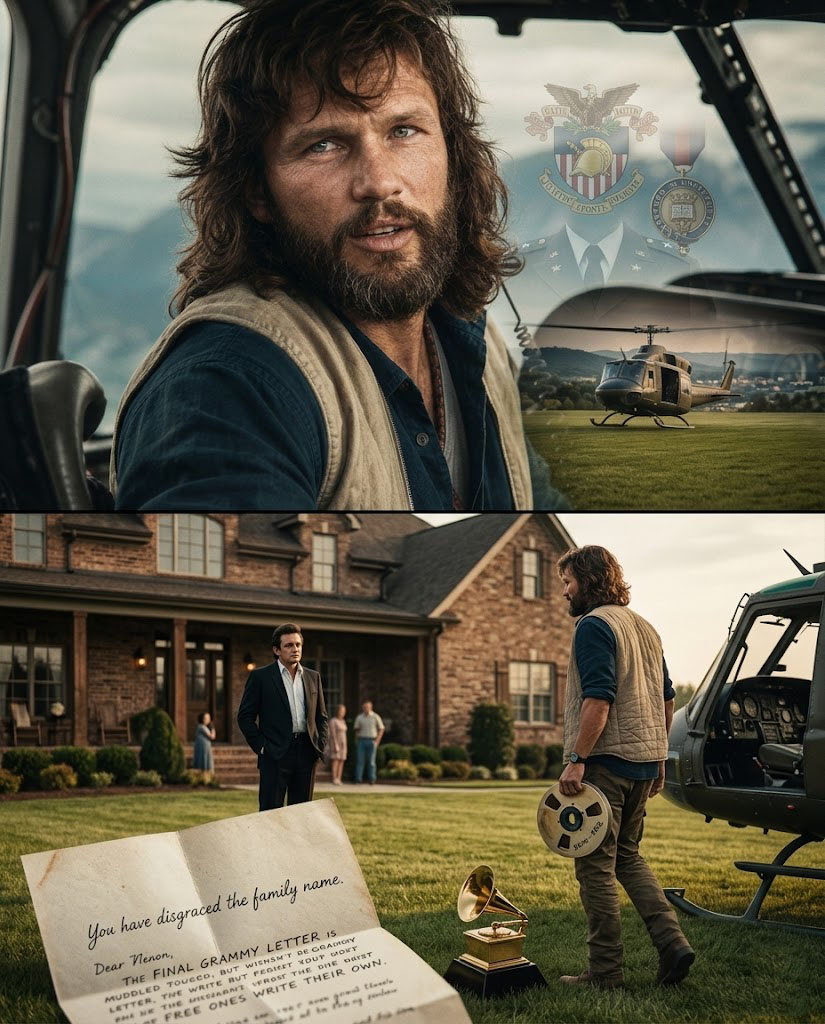
THEY CALLED HIM A DISGRACE FOR THROWING AWAY HIS FUTURE — THEN HE LANDED A HELICOPTER ON JOHNNY CASH’S LAWN TO PROVE THEM WRONG…
Kris Kristofferson was supposed to teach English literature at West Point. He was a celebrated Rhodes Scholar and a highly respected Army Captain.
Instead, in 1969, he flew a National Guard chopper right into the front yard of the Man in Black. He stepped out of the cockpit with a demo tape tightly in his hand.
Cash finally listened. Nashville would never be exactly the same again.
THE SECURE ROAD
Lars Kristofferson was an Air Force Major General. His family spoke the strict language of military discipline, posture, and undeniable duty. A son did not simply choose a life.
Kris was the perfect heir to that proud tradition. He studied at Oxford. He learned to fly heavy machines. He wore an officer’s uniform with immense pride.
In 1965, the Army handed him the ultimate prize. They offered him a prestigious teaching post at West Point. His future was clean, honorable, and completely guaranteed.
But two weeks before it began, he quietly resigned his commission.
He packed up his young family and drove away from everything he understood. He traded guaranteed stars on his shoulders for an empty highway leading straight to Tennessee.
THE DEFIANT TRUTH
His parents did not hide their deep disappointment. His mother wrote him a letter shortly after he left, officially calling him a disgrace to the family name.
A man who had mastered academic halls was suddenly sweeping floors. He took a job as a janitor at Columbia Recording Studios. He emptied ashtrays in the shadows while true stars stood at the microphones.
The daily rejection was steady and quiet. The dream did not arrive polished. Nobody wanted to hear a struggling poet with an Oxford degree.
To feed his children, he flew commercial helicopters over the Gulf of Mexico. He sat on lonely oil rigs between long shifts, writing songs about freedom, profound regret, and the heavy ache of being human.
He was living his own defiant truth. He chose an uncertain road because the safe one simply felt like a quiet surrender.
Then came that desperate afternoon in 1969.
He did not ask for permission. He simply lifted off in a chopper, guided it over Hendersonville, and set it down on Johnny Cash’s sprawling property.
It was a calculated gamble born from pure exhaustion. He needed someone to hear the deeply personal words he could no longer hold inside.
A DIFFERENT KIND OF HONOR
The reckless gamble worked. His songs found their way to Janis Joplin, Elvis Presley, and the very man whose lawn he boldly invaded.
He did not just succeed inside the Nashville system. He changed the entire room. He brought a rare literary weight to country music without ever making it feel cold or distant.
His family desperately wanted him to protect the respectable dream they had built. He chose to burn the map and bravely draw his own.
He never became the decorated general his father expected. He became something much lonelier, and infinitely more lasting.
Sometimes history remembers a man not for the strict orders he followed, but for the one heavy order he finally refused…