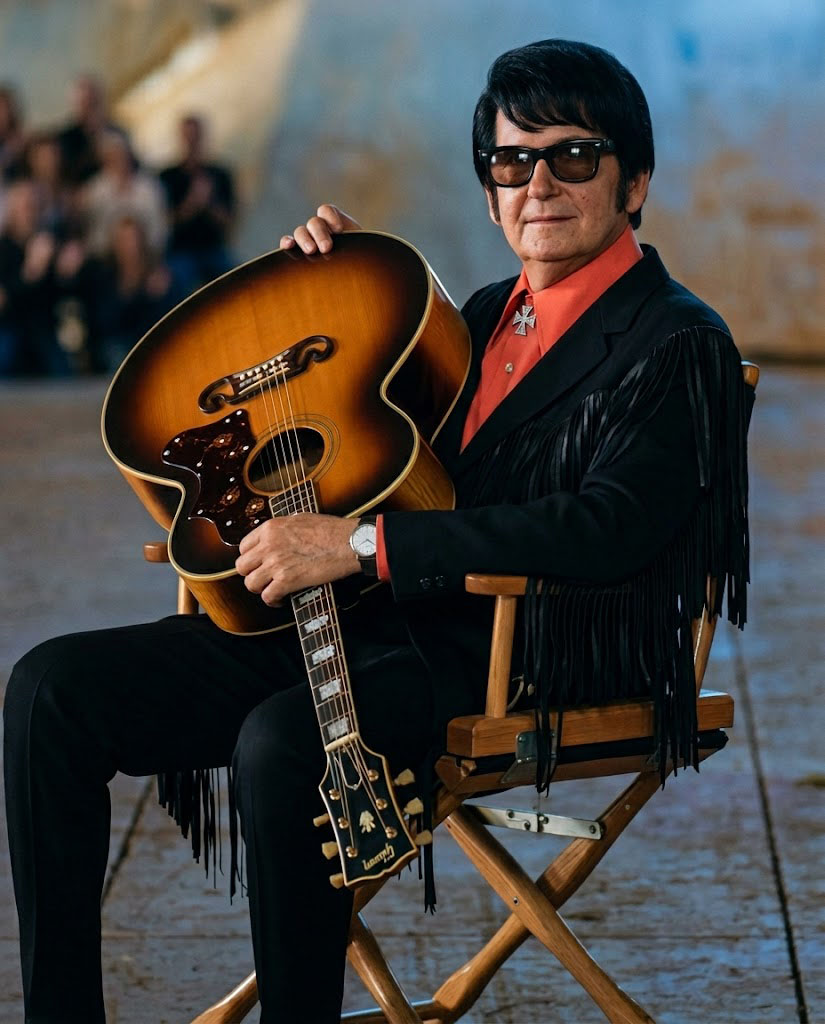
THE WORLD HEARD A CAREFREE TUNE ABOUT FLASHING LIGHTS — BUT BEHIND THE DARK GLASSES, A FATHER BROKEN BY UNIMAGINABLE LOSS WAS JUST TRYING TO SURVIVE THE SONG.
To watch Roy Orbison perform was to witness a masterclass in absolute stillness.
In an era where rock and roll artists danced, sweated, and tore across the stage to command a room, Roy just stood there.
He didn’t rely on flashy choreography or loud stage banter. He was a solitary figure anchored to the stage, letting the raw emotion of his vocal cords wash over the crowd.
Dressed immaculately in black, hiding entirely behind his trademark thick dark shades, he never needed to move.
He let his voice do all the bleeding for him.
When his single “Penny Arcade” hit the airwaves in 1969, it sounded like pure, untethered joy.
It was an upbeat, catchy, bouncing pop song about a noisy amusement center. It made people roll their car windows down, tap their feet against the floorboards, and smile at the radio.
But context changes everything.
If you pull back the curtain on the year that song was recorded, the cheerful melody suddenly becomes one of the most heartbreaking acts of endurance in American music history.
Just a few years prior, in 1966, Roy’s world had been completely shattered. His beloved wife, Claudette, was killed in a sudden motorcycle accident right in front of him.
He was still trying to piece his broken soul back together when the absolute unthinkable happened.
In the fall of 1968, while Roy was away on a working tour in England, a devastating house fire burned his Tennessee home to the ground.
It took the lives of his two beautiful little boys, Roy DeWayne and Anthony King.
He was only thirty-two years old. In the span of just twenty-four months, he had lost the three people he loved most in the entire world.
The music industry assumed he was done.
Nobody would have blamed him if he had walked away from the microphone forever, retreated into the quiet shadows, and never sang another note for the rest of his life.
But by the time he stepped back into the recording studio in 1969, he wasn’t just an entertainer anymore.
He was a man with a completely shattered heart, holding onto a microphone stand because it was the only thing keeping him on his feet.
Music had become his last remaining lifeline.
Listen closely to “Penny Arcade” today, knowing what he had just buried in the ground.
Pay attention to that soaring, impossible, operatic chorus.
Amidst the cheerful arrangement and the bouncing rhythm, his voice carries a heavy, haunting weight that completely betrays the tempo.
He wasn’t really singing about a noisy carnival.
For those who knew his story, the illusion of the pop song fades away. He sounded exactly like a man desperately longing to return to a simpler, happier time.
He was singing about a place where the bright lights were still on, where children were still running and laughing, and where the world hadn’t yet taken everything he held dear.
He wasn’t singing to entertain the crowd.
He was singing because the deafening silence waiting for him back in that empty house was simply too loud to bear.
Roy wrapped his profound, unimaginable agony in a cheerful melody, hiding his grief in plain sight so that the rest of the world wouldn’t have to carry the weight of his pain.
He gave us songs to cry to, to dream to, and to heal to, even when he couldn’t find healing for himself.
The flashing lights of a penny arcade always go out eventually.
But long after the music fades, that solitary voice still echoes in the dark—reminding us that sometimes, the most beautiful sounds come from a heart just trying not to break completely.