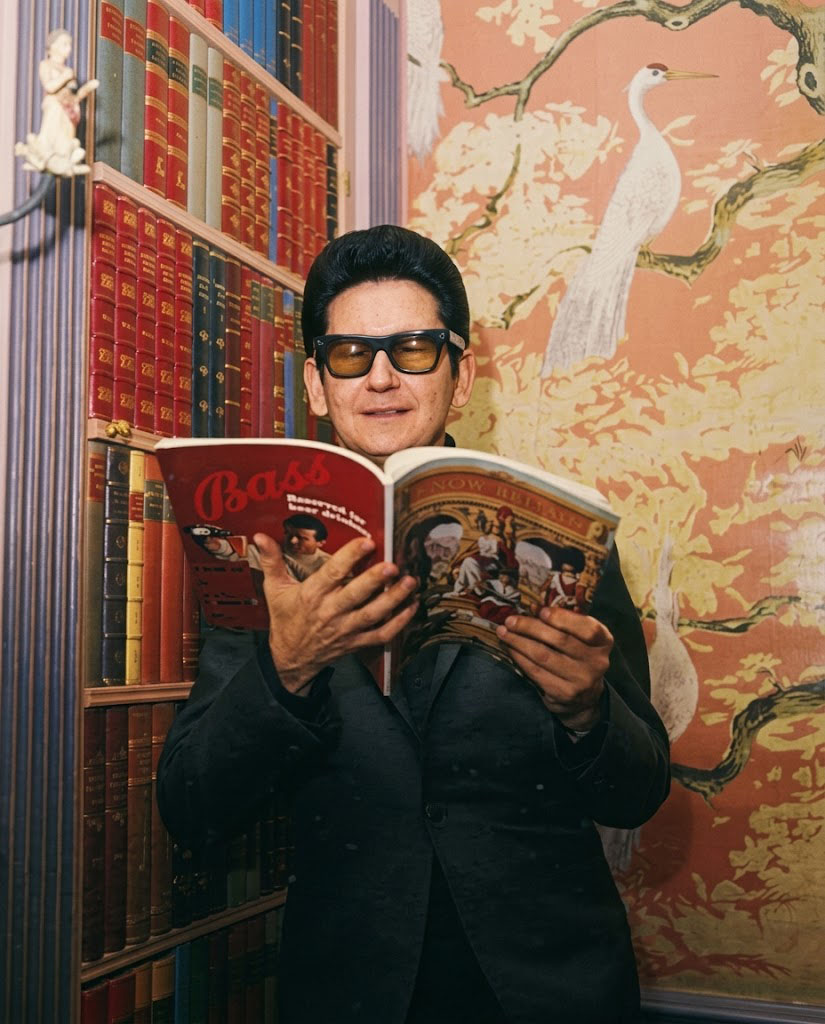
THE WORLD KNEW THE DARK GLASSES AND THE STILLNESS — BUT WHEN THAT FINAL POSTHUMOUS TRACK PLAYED, THEY HEARD A MAN WHO HAD SURVIVED UNTHINKABLE TRAGEDY STILL DRIVING TOWARD THE LIGHT.
Roy Orbison wasn’t just a rock and roll pioneer.
He was the architect of the most beautiful loneliness in American music.
While other stars of his era danced, shouted, and chased the spotlight, Roy stood perfectly still. He dressed in obsidian black, hid behind thick, dark sunglasses, and barely moved a muscle on stage.
To the public, it was an aesthetic. A carefully crafted aura of mystery that made the “Big O” an untouchable icon.
But those glasses weren’t just a costume. They were a shield for a man who had looked at unimaginable tragedy and somehow found a way to keep his eyes open.
The world loved his soaring ballads, but few understood the heavy toll exacted on the man singing them.
In 1966, he lost his beloved wife, Claudette, in a tragic motorcycle accident while they were riding together.
Just two years later, while he was thousands of miles away playing a show in England, a devastating house fire took the lives of his two eldest sons.
Most men would have shattered into a million unrecoverable pieces. Most would have walked away from the microphone forever, unable to let another note pass through a throat tight with that much grief.
But Roy Orbison didn’t quit. He took all that silence, all that unbearable emptiness, and poured it straight back into the studio.
He carried a wound that no amount of applause could ever heal, yet his voice remained as pure and gentle as a prayer.
When he walked into a studio in 1987 to record “I Drove All Night,” he was in the final chapter of his life, though no one knew it yet.
The song was shelved. It wasn’t released until 1992, four years after Roy’s own sudden and fatal heart attack.
When it finally found its way to the public, it didn’t sound like a standard pop track returning from the grave. It felt like a transmission from a place where time and loss no longer held any power.
Listen closely to the soaring, desperate quality in his voice as the chorus hits.
It isn’t just a song about a late-night romantic drive across state lines.
To those who knew his story, it sounded like a man who had reached the absolute edge of the world, staring into the dark, willing to keep his foot on the gas just to see the silhouette of the family he had lost.
He wasn’t singing for a record label. He was singing like someone trying to cross the boundary between this life and the next.
That was the true power of Roy Orbison. There was no choreography, no cheap tricks, no fake emotion.
There was only the raw, aching reality of a human heart trying to outrun its own sorrow, captured in a four-octave range that could make a crowded room drop into absolute silence.
He gave a voice to the lonely nights, the empty passenger seats, and the haunting memories that refuse to fade when the sun goes down.
People didn’t just listen to Roy to hear a good melody. They listened to him because he made it feel okay to be completely, hopelessly broken.
He showed an entire generation that you could carry a mountain of pain and still produce something incredibly beautiful.
Though his physical journey ended far too soon, and the man in the dark glasses has been gone for decades, the music keeps rolling down the highway.
His voice still finds the people who need it the most, exactly when they need to hear it.
Sometimes, when the house is quiet, the night is long, and the radio plays that final, soaring note, you don’t just hear a fallen legend.
You hear a man who never stopped driving through the dark, finally heading toward a sunrise where everyone he loves is waiting.