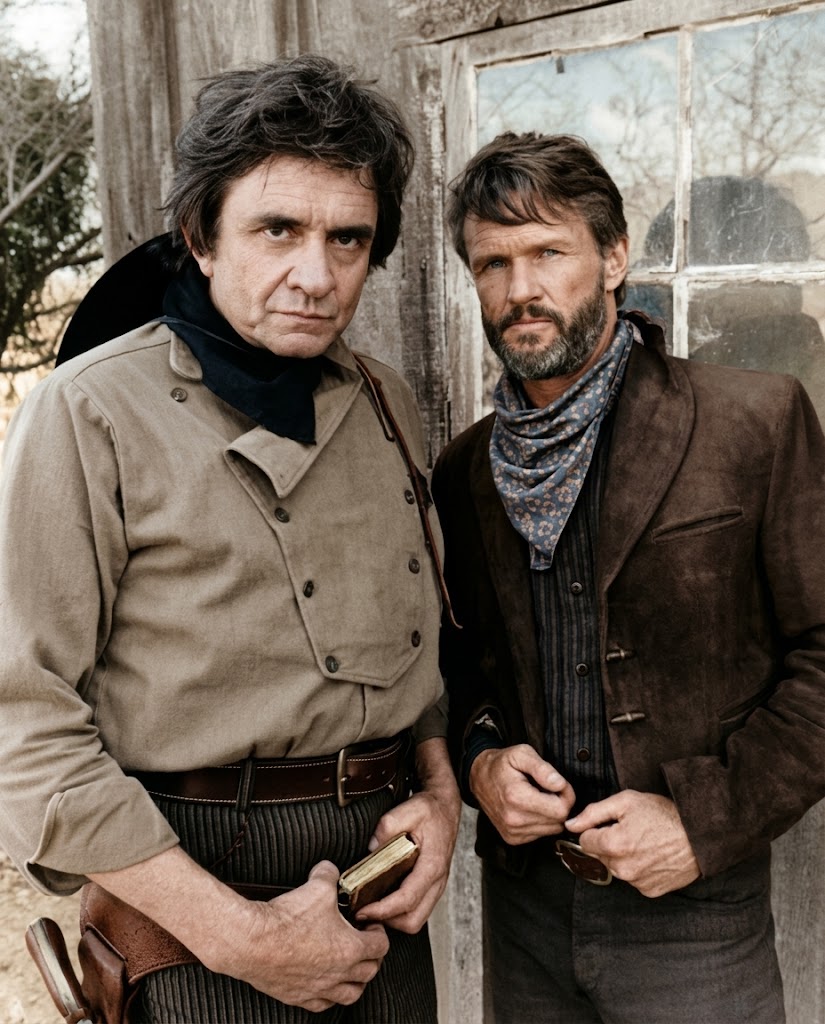
HIS FAMILY DISOWNED HIM FOR CHOOSING A GUITAR OVER A GENERAL’S STAR — BUT THE JANITOR WITH AN OXFORD DEGREE ENDED UP PENNING THE VERY SOUL OF AMERICA…
Kris Kristofferson had everything a man could possibly want, except his own life.
He was the son of an Air Force major general. He was a brilliant Rhodes Scholar at Oxford, a golden boy who played rugby and studied the poetry of William Blake.
He was an Army Ranger pilot with a path to greatness already paved in heavy gold.
But greatness, for Kris, didn’t wear a military uniform.
The turning point came when he was offered a prestigious teaching post at West Point. It was the final, expected step in a perfect, respectable life.
Instead, he drove his car to Nashville.
When he resigned his commission to chase a wild, uncertain dream, his mother sent a letter. She told him he was an absolute embarrassment to the family name. She told him never to come home.
Overnight, the decorated captain became a ghost.
He traded a guaranteed, comfortable future for a broom. He took a job sweeping floors and emptying ashtrays at Columbia Studios in Nashville.
He wasn’t there for the paycheck. He just wanted to breathe the same air as the musicians he worshipped.
He would stand quietly in the shadows while men like Johnny Cash and Bob Dylan recorded, watching the magic happen from the edge of the room. He was a fly on the wall in the presence of greatness.
He was broke. His marriage was falling apart. He was entirely, profoundly alone.
But inside that heavy isolation, he didn’t break. He simply began to write.
He didn’t write the polished, manufactured hits that Music Row was looking for. He wrote lyrics with a brutal, bleeding honesty that country music had never truly seen before.
He wrote about hangovers, empty sidewalks, and the hollow ache of waking up with nothing but the clothes on your back.
When he penned “Sunday Mornin’ Comin’ Down,” he wasn’t trying to win the Grammy Awards that would eventually fill his shelves. He was just a man trying to survive his own choices.
He was writing the truth of his own cracked-open life.
But nobody was listening to the janitor. He was getting older, the rejections were piling up, and the dream was starting to look like a terrible mistake.
Then came the moment that changed everything.
Desperate to get his songs heard, the former Army pilot climbed into a helicopter. He flew it right onto the front lawn of Johnny Cash’s house, clutching a demo tape in his hand.
It was a crazy, reckless move. But it worked.
Johnny Cash listened. And the Man in Black immediately recognized the absolute genius behind the ragged, exhausted poet.
When Cash sang “Sunday Mornin’ Comin’ Down” on national television, he didn’t just sing a song. He forced the whole world to look at the man who wrote it.
Suddenly, the janitor wasn’t sweeping floors anymore.
Kris Kristofferson went on to write “Me and Bobby McGee,” “Help Me Make It Through the Night,” and “For the Good Times.” He didn’t just write country music; he redefined what a country song could be.
He brought the poetry of Oxford into the smoky dive bars of America.
He didn’t have the most polished voice in Nashville. It was rough, gravelly, and entirely imperfect. But when he sang, you didn’t care about perfect pitch. You cared that he meant every single word.
He went on to stand shoulder-to-shoulder with the giants, becoming a Highwayman alongside Cash, Waylon Jennings, and Willie Nelson. Yet, even among legends, he was the undisputed poet laureate of the group.
Though Kris is gone, what remains is far greater than any military medal he could have ever earned.
His voice still lives in the quiet moments of the night, when people need a song that understands exactly what it feels like to lose everything.
He left behind a timeless catalog of human heartbreak.
He proved that sometimes, you have to burn down the life you were supposed to live, just to become exactly who you were meant to be.