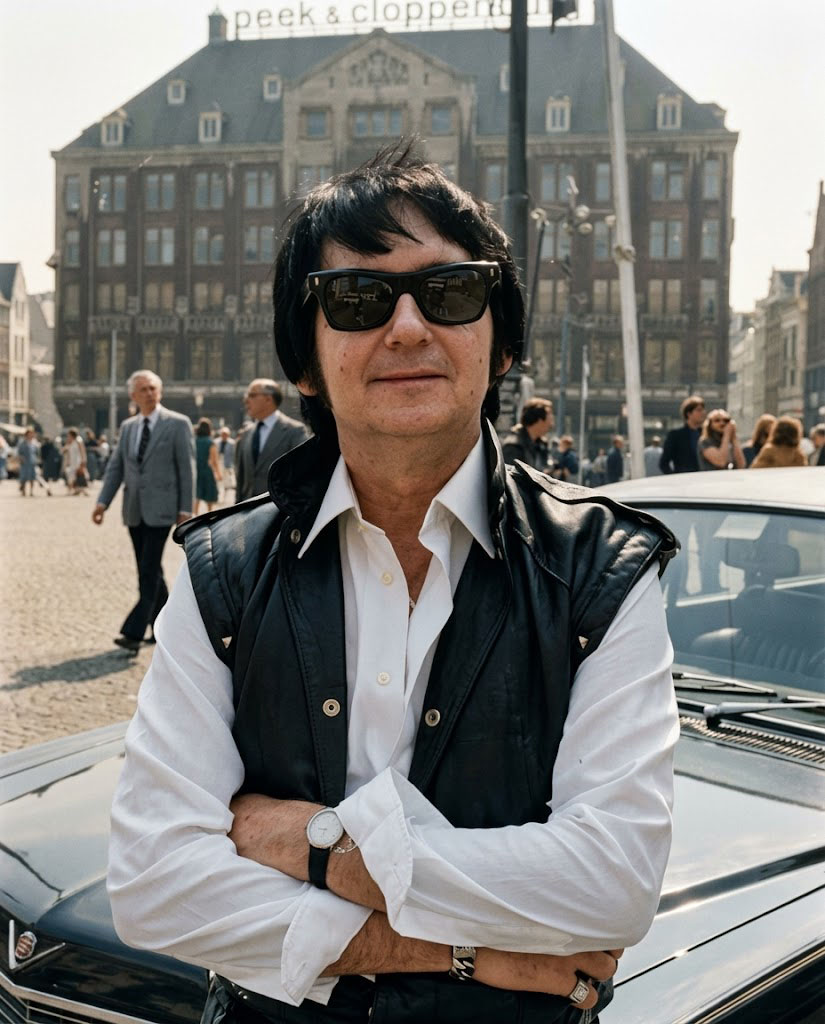
HE LOST ALMOST EVERYTHING A MAN COULD LOSE BEFORE FINALLY STEPPING BACK INTO THE LIGHT — BUT ONE LATE-NIGHT STUDIO SESSION REVEALED HE WAS ALREADY SAYING GOODBYE.
The world knew Roy Orbison as the quiet enigma behind the dark Ray-Bans.
He was the man with the soaring, operatic tenor that made even Elvis Presley nervous. The voice that sounded like a velvet teardrop falling into an empty canyon, effortlessly bridging the gap between rock and roll and pure heartbreak.
But behind the effortless grace of his music, Roy carried a quiet, unimaginable weight.
The late 1960s had taken almost everything from him in rapid, brutal succession. First, he lost his wife, Claudette, in a tragic motorcycle accident. Then, while he was away on tour trying to hold his shattered life together, two of his young sons perished in a devastating house fire.
Most men would have walked away from the microphone forever. Most men would have let the silence win.
Roy simply put on his dark glasses, stepped back into the lonely spotlight, and allowed the grief to weave itself into the very fabric of his vocal cords.
For decades, he quietly endured the changing tides of the music industry. He played the smaller rooms, he sang the old hits, and he carried the ghosts of his past with a quiet, unbroken dignity.
Then came 1988. Against all odds, Roy Orbison was standing in the warm glow of a miraculous, late-career resurrection.
He was riding high with the Traveling Wilburys, standing shoulder-to-shoulder with Bob Dylan, George Harrison, and Tom Petty. He was finally being celebrated not just as a nostalgic memory, but as the living legend he had always been. He was recording Mystery Girl, his first album of new material in almost a decade.
It was supposed to be the triumphant final act of a beautiful comeback story.
But fate, and a song born entirely from a dream, had a different plan.
Thousands of miles away in London, U2’s Bono woke up in the middle of the night with a haunting melody playing in his head. But it wasn’t his own voice singing it in the dark. It was the trembling, fragile, yet overwhelmingly powerful voice of Roy Orbison.
Bono wrote “She’s a Mystery to Me” specifically for that phantom voice, completely unaware that he was writing the soundtrack to a quiet goodbye.
When Roy stepped into the vocal booth to record the track, the room felt different.
He didn’t know his weary, overworked heart was just weeks away from failing him. He didn’t know this would be one of the last times he would ever stand behind a studio microphone.
But when you listen to the vocal track from that session, you can hear a man who is no longer just singing a cinematic ballad.
He was pouring the very last embers of his spirit into the microphone. His delivery possessed a fragile, otherworldly beauty, completely untouched by time but impossibly heavy with the weight of a long, bruising journey.
He wasn’t singing for a chart position. He was singing like someone standing on the quiet edge of the world, looking back at the beauty and the sorrow one last time before stepping into the shadows.
Just weeks later, on December 6, 1988, Roy Orbison suffered a fatal heart attack. He was only 52.
He never lived to see the album released. He never got to watch the world weep for his final masterpiece.
When “She’s a Mystery to Me” plays out of a speaker today, it doesn’t sound like a standard studio recording anymore.
It feels like a phantom whispering through the dashboard of a lonely midnight drive.
It is a quiet, breathtaking reminder that even as his own lights were finally going out, the man in the dark glasses still knew exactly how to break our hearts.