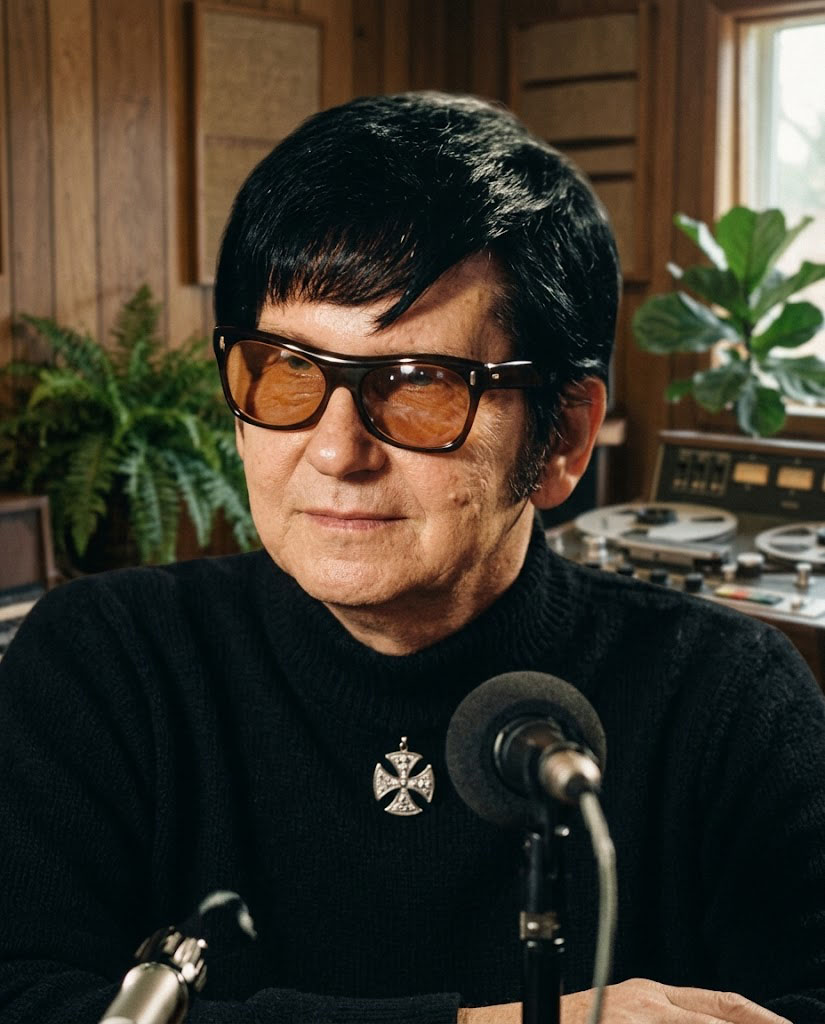
HE LOST THE LOVE OF HIS LIFE IN A SUDDEN TRAGEDY — BUT WHEN HE RETURNED TO THE MICROPHONE, HE DID NOT SING; HE BLED.
For years, America believed they understood his sorrow. Roy Orbison stood frozen on dimly lit stages, hidden behind thick, black Ray-Bans, dressed like a man perpetually attending a funeral.
He was the undisputed architect of musical heartbreak. With a soaring, operatic voice, he delivered sweeping tales of romantic devastation. When he sang “Crying” or “Only the Lonely,” listeners felt an elegant, almost theatrical kind of sadness. We thought that was the absolute peak of human pain.
We didn’t know the real heartbreak was still waiting in the wings.
Behind the lonely public persona, Roy was a man deeply in love. His wife, Claudette, was his anchor. She was the literal inspiration for his monumental hit, “Oh, Pretty Woman.” When she walked into a room, his world lit up. Together, they shared a fierce passion for motorcycles, often escaping the suffocating pressures of fame to find freedom on two wheels across the open highways of Tennessee.
Then came June 6, 1966.
A sunny afternoon ride through Gallatin ended in a horrifying shatter of metal, glass, and asphalt. A truck pulled out into their path. A crash echoed across the highway. And just like that, the woman who was the center of his universe was gone.
The man who had built an entire empire singing about imaginary breakups was suddenly standing in the wreckage of a very real, terribly permanent goodbye. The theatrical sadness of his early hits was instantly eclipsed by a suffocating, unbearable reality.
He could have retreated into the shadows forever. The grief was paralyzing. Nobody would have blamed him if he locked his guitar in a case and never stepped up to a microphone again.
But Roy Orbison was a musician down to his very bones. The only way he knew how to survive the deafening silence of an empty house was to fill it with sound.
Just two months later, still drowning in the aftermath of the tragedy, he walked back into a recording studio. He didn’t bring a heavily produced pop anthem. He didn’t even sing a song he had written to explain his grief.
Instead, he reached back for a decade-old country track written by Don Gibson: “Too Soon to Know.”
It was supposed to be a standard, mournful ballad. But in the late summer of 1966, standing in the lonely glow of the studio lights, a shattered Roy Orbison transformed it into something almost too painful to witness.
He stood in front of the microphone, his dark glasses now hiding a grief too profound for public consumption. When he opened his mouth, his smooth, effortless tenor was laced with a trembling, devastating truth.
He wasn’t performing anymore. He was singing like a man trying to make it through one more night. He was trying to figure out how to take his next breath without her.
Every soaring note felt less like music and more like a desperate, pleading transmission into the void. The lyrics spoke of a heart struggling to comprehend an impossible reality. Listeners everywhere heard the track and immediately understood the gravity of what was happening.
The recording was so raw, so uncomfortably intimate, that it sent a shockwave through the airwaves. In America, some radio stations hesitated to play it. Disc jockeys felt almost intrusive broadcasting it. It didn’t sound like a commercial radio hit; it sounded like a man bleeding out on vinyl.
You could hear the exact moment a human soul fractured.
“Too Soon to Know” didn’t fix the empty side of his bed. It didn’t bring Claudette back. But for three fleeting minutes, it gave him a place to put the heavy, suffocating pain when his own hands could no longer carry it.
Roy Orbison would go on to face even more unimaginable tragedies in his life, enduring fires and losses that would have broken anyone else. Yet, he never completely surrendered to the dark.
He kept the glasses on. He kept walking back toward the music. He kept carrying the memory of the people he loved, turning his deepest wounds into a bridge for anyone else who felt alone in the world.
Today, when that specific record spins, you aren’t just hearing a legendary voice from the 1960s. You are hearing a husband standing in the absolute center of his darkest night.
A man who proved that sometimes, the only way to survive the crushing silence is to sing right through it.